

If you were willing to live like it's 1930 (one radio, probably no fridge), you could work about seven hours a week and call it a day.
That number is hiding at the bottom of a chart Steve Rattner published in the New York Times this month, and I have not stopped thinking about it. Technology made us ridiculously more productive over the last 200 years. We spent almost all of it on stuff, not time.
AI is about to hand every business another big batch of productivity. Where it goes will get decided by default unless somebody decides on purpose.
This week:
What Keynes got right and wrong about the 15-hour week, and how to decide where your AI hours go
What actually changed when Chat and Cowork became one Claude
Claude Dashboards and Motion, $1.8 billion to build a virtual cell, and a big new American open model
The Deep Dive
Keynes Promised Us a 15-Hour Week. We Bought Stuff Instead.
In 1930, John Maynard Keynes predicted that his grandkids' generation would work about 15 hours a week. Technology would make us so productive that earning a living would stop being the main problem in life.
Steve Rattner just published a chart in the New York Times, part of his essay Six Charts That Show Just How Much We Need A.I., that grades that prediction. It's one of the best charts I've seen all year.
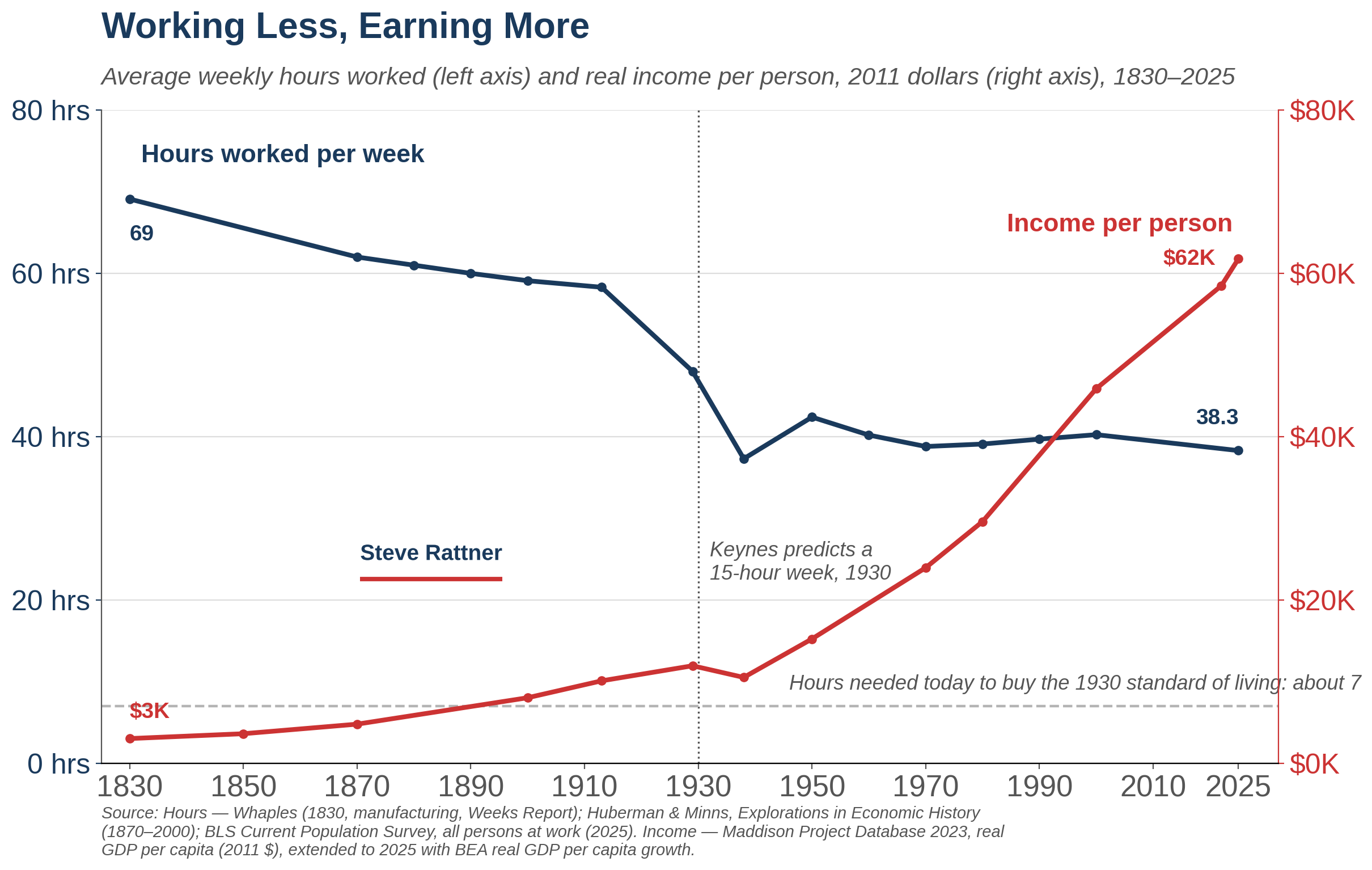
In 1830 the average paid factory worker, mostly in Northern mills, put in 69 hours a week, roughly sunup to sundown, six days a week. (That number comes from old factory payroll records, so it only covers paid workers. The roughly 2 million people enslaved at the time aren't in it, because their labor was forced and unpaid and never appeared on anyone's payroll.) By 2025 the average American worker was at 38 hours a week. Over the same stretch, real income per person went from about $3,000 to $62,000. Rattner's caption: properly managed, AI can do the same.
Keynes was right about the productivity. The dotted line at the bottom says it now takes about seven hours of work a week to afford the 1930 standard of living. His 15-hour week is sitting right there for anyone who wants to live like 1930.
Nobody wants to live like 1930. So look at what happens after 1950. The hours line goes flat and the income line takes off. For 75 years, nearly every bit of new productivity went into earning more instead of working less. We got bigger houses and a computer in every pocket. We did not get Fridays.
Nobody voted on that. Millions of companies and workers made the call one raise at a time without ever really making it.
Default is exactly what I see with AI right now. One study this summer found workers getting back more than two hours a day from AI tools, and the researcher's own conclusion was that most of that time will get filled with new work, not handed back. More email. More meetings. A slightly faster version of the same job.
"Properly managed" is doing a lot of work in Rattner's sentence, and he knows it. Another chart in the same essay shows that so far the gains from AI have gone mostly to investors, not workers. Productivity going up is one question. Who gets it is a separate one.
You can't decide that for the whole economy. You can decide it for your business, and it's much easier to decide before the hours show up than after.
So when you roll out an AI workflow, write down before it goes live what the saved time is for. Maybe it's taking on more clients with the same team. Maybe it's the service you never had the capacity to offer. Maybe it's your people leaving at 3 on Fridays because they earned it. Any of those is a fine answer. "We'll see" is the only bad one, because "we'll see" turns into more email.
From the Field
Chat and Cowork Are One Claude Now. Here's What Actually Changes.
On September 16, Anthropic merged Claude Cowork into regular Claude chat. It rolled out to Pro and Max first, with other plans following. If your message box no longer asks you to pick between Chat and Cowork, you're on the new version.
The problem it fixes is one we ran into in nearly every team training: "Does this go in Chat or Cowork?" People would start a report in chat, realize it needed their files and connectors, and start over somewhere else. Anthropic said it plainly in the announcement. Deciding where a task belonged was the frustrating part.
Now you just ask. A quick question stays quick. A report becomes a task Claude keeps working on after you close your laptop, and you can schedule it to run every Monday. Your skills, connectors and projects follow you into every conversation. By default Claude still asks before it takes an action, so a person signs off on anything that matters.
Two things worth doing this week. Open Settings and find Instructions for Claude, because your old Cowork instructions live there now, and clean out anything you had duplicated. And if your team used the standalone Claude Design site, migrate your design systems. It shuts down December 14.
Why this travels: every company has a tool its people only half use because they aren't sure where things go. Take away the decision and people actually use it.
AI News Worth Your Time
Three Stories From This Week
Claude can now build your dashboards and animate your board deck
On October 8, Anthropic launched Claude Dashboards and Claude Motion in beta. Dashboards connects to data platforms like BigQuery, Snowflake and Databricks, or to a CRM like Salesforce, and builds a live dashboard from a plain-English question that stays current as the data changes. Click any number and you see the exact query behind it. Motion turns a quarterly report or a chart into a short animated explainer, built as editable code instead of generated video, and exports as an MP4. Dashboards is on paid plans, Motion is Team and Enterprise only, and Docs, Slides and Design came out of beta the same day on every plan, including Free.
My take: The feature I care about is the query behind every number. The biggest reason owners don't trust AI with their numbers is that they can't see how it got them. Now your finance person can check the work before it goes in front of the board. Motion is the sleeper. Most small businesses will never hire a motion designer, and now the quarterly update can actually move. READ THE ANTHROPIC ANNOUNCEMENT →
Big Tech and the government put $1.8 billion into teaching AI how cells work
On October 7, Biohub, the Department of Energy and the NIH announced a major expansion of the Virtual Biology Initiative, with $1.8 billion in funding, data, computing and new lab technology. DOE is putting in more than $500 million over five years, NIH is organizing datasets built from more than $500 million in past federal research, and Google DeepMind, Isomorphic Labs and Meta are adding $300 million between them. The goal is an open, standardized pile of data for training AI models that predict how a cell responds to a drug or a change. Scientists call it a virtual cell, and the idea is to run experiments on a computer before running them in a lab.
My take: The headline is the money. The story is that almost all of it goes to data, not models. The labs already have good models. What they don't have is clean, organized data to point them at. Your business has the same problem at a smaller scale. The company whose customer records live in one clean system gets more out of Claude than the company whose records live in four spreadsheets and somebody's inbox, even though they pay for the same subscription. READ THE BIOHUB ANNOUNCEMENT →
An American lab just built a 501-billion-parameter model it's giving away
On October 5, Reflection AI introduced Beam, its first open-weight model, meaning anyone will be able to download and run it. It has 501 billion parameters, uses 23 billion of them for any given word, and is built for coding and agent work. Reflection says it's competitive with GLM 5.2 on coding while using three to four times less computing power on reasoning tasks, and admits Kimi K3 is still ahead on raw capability. The weights come out later this month under a license that lets businesses use it freely, and there's a waitlist for early access now.
My take: Most of our clients will never download a model, so why care? Two reasons. Good, cheap open models put pressure on everyone's prices, including the tools you already pay for. And if you're in a regulated industry where data can never leave your own servers, a strong open model from a U.S. lab is a real option. Last month I told you to ask where the cheap models you're being pitched came from. This one at least has an answer. Wait for independent testing before you believe any launch-day benchmark, though. READ THE REFLECTION ANNOUNCEMENT →
That's it for this week.
If this was useful, forward it to the person in your company who keeps saying AI is going to give everyone Fridays off. That's who this is for.
And if you want to talk about what AI could do for your business, not in theory, but in your workflows, with your team, on your timeline, reach out at [email protected]. That's what we're here for.

Dean led AI initiatives for a 500-person division at Epic Systems before founding Bridge AI, the embedded AI team for small and mid-size businesses.