
Pick a number between 1 and 10. Go ahead, I'll wait.
If you said 7, congratulations. You think like a chatbot. (The screenshot up top is me asking Claude the same question. It did not need long to think about it.)
That little 7 says a lot about how AI actually works. It also explains why so much AI-written stuff is starting to sound exactly the same, and why your customers can tell.
If you use AI for anything a customer will ever read, this one is for you.
This week:
Why everyone's AI picks 7 (and what to do about it)
How to set Claude up to get a little smarter every day without you lifting a finger
Anthropic puts 5% of its shares toward the public good, AI helps bring back the dodo, and UK cameras catch 19,000 drivers in two weeks
The Deep Dive
Lucky Number 7
There's a graph going around X right now that shows how three different things answer "pick a number between 1 and 10": a true random number generator, humans, and an LLM.
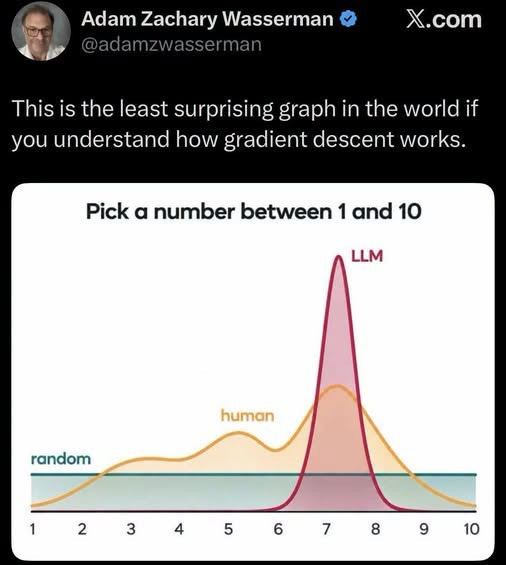
Random is flat. Every number gets the same shot. Humans are lumpy. We avoid 1 and 10 because they feel too obvious, and we lean toward 7 because 7 feels random. The LLM is one giant spike sitting right on top of 7.
The reason comes down to how these models learn. A model like Claude reads an enormous amount of human writing and gets very, very good at predicting the most likely answer. Then it goes through more training to turn it into a helpful assistant, and that training rewards safe, crowd-pleasing responses. So it takes our small human lean toward 7 and turns the volume all the way up.
AI didn't invent the 7. We did. It just learned it from us a little too well.
Now for the business part. The most likely answer is also the answer everyone else gets.
Say you own a landscaping company and you ask Claude for a tagline. Your competitor across town asks for one too. There's a real chance you both walk away with something that looks a lot like the 7. Same goes for cold emails, LinkedIn posts, and the "About Us" page on your website. Your prospects have read a thousand of those 7s by now, and they can spot one in the first line.
The spike isn't always bad, by the way. For plenty of work you want it. When Claude is categorizing expenses or pulling numbers off invoices, you want the same right answer every single time. Boring is the goal there.
The trouble starts when you need to stand out. Two things help a lot:
Feed it what only you have. Your customers, your best past work, the way you actually talk, the odd detail that makes your business yours. Context is what pulls it off the 7.
Ask for the spread, not the answer. Don't ask for a tagline. Ask for 15 and tell it to skip the obvious ones. The good stuff usually lives out at 3 and 9.
And a quick PSA while we're here: never let AI pick the raffle winner. LLMs are terrible at being random. If something needs to be fair (a giveaway, which invoices get audited, which leads get the test offer), have Claude write a few lines of code that rolls the dice for you. The code is random. Claude picks 7.
From the Field
Teach Claude to Get Better While You Sleep
Here's a setup I love, and the NBA season just tipped off, so the timing is perfect.
Say you want Claude to predict tonight's NBA scores every morning.
In the morning, a scheduled task tells Claude to open a specific page in Notion and follow the instructions on it. That page is its playbook: which models to build, what news to check (injuries, back-to-backs, travel), and how to make the picks.
At night, after the last game ends, a second scheduled task kicks off. It pulls the real scores, compares them to the morning's picks, and works out what it got right, what it got wrong, and why. Then it thinks hard and rewrites the playbook in Notion.
The next morning, the first task reads the updated playbook and goes again. Every day it starts a little sharper than the day before, and you don't have to do a thing.
Basketball is just the fun version. The same loop works anywhere you make a guess today and find out tomorrow whether you were right.
A restaurant could have Claude predict tomorrow's prep every morning (how many pounds of chicken, how many trays of fries) and then compare it at close to what actually sold and what got thrown out. Over a few weeks the playbook fills up with rules nobody ever wrote down before, like "rainy Tuesdays, cut fries."
A business owner could have Claude forecast this week's incoming cash every Monday, then check it against the bank on Friday. It learns which clients always pay late and which months are slow, and the forecast tightens up.
One rule I'd never skip: have the nightly task log every change it makes at the bottom of the Notion page, with the reason. If one bad night makes it overcorrect, you can roll it back in a minute. And a human should read that log every week. Claude does the grading, but you still decide whether the lessons make sense.
Every business makes educated guesses every day and finds out later how they did. Most never write down what they learned. This loop does it for you, every night.
AI News Worth Your Time
Three Stories From This Week
Anthropic puts 5% of its company toward the public good
On Sunday, Anthropic announced it's committing 5% of its shares to a new Anthropic Public Benefit Fund, worth about $48 billion at the company's last valuation. The fund can grow as Anthropic becomes more valuable, with the board able to add more equity as the valuation climbs. It's set up as an LLC owned by Anthropic rather than a charity, and none of the money can go to lobbying or political donations. Anthropic named workers hurt by AI as one example of who it could help, and says roughly 20% of its shares are now committed to the public good when you count earlier pledges from founders and employees.
My take: I like that the giving is tied to the company's growth. If AI disrupts more jobs, the company profiting from it ends up with more money set aside to help. The big open question is who decides where the money goes, and Anthropic hasn't published those rules yet. For business owners, it's a reminder that the job-disruption conversation is now real enough that the companies building these tools are budgeting for it. READ THE EWEEK REPORT →
AI is helping bring back the dodo
Colossal Biosciences, the Dallas company trying to "de-extinct" animals, announced progress on bringing back the dodo. The big problem was data: scientists only have one complete dodo genome, so they couldn't compare dodos to each other to figure out which genes made a dodo a dodo. Colossal built an AI platform called GenoMorph that narrowed hundreds of thousands of possible genetic changes down to the handful most likely to explain the dodo's famous beak and face. The plan is to edit those traits into the Nicobar pigeon, the dodo's closest living relative.
My take: Fun story, but there's a real business lesson hiding in here. A lot of owners tell me they don't have "enough data" for AI to be useful. Colossal had exactly one genome and still got somewhere, because they pointed AI at a very narrow question. You don't need a mountain of data. You need a specific question. READ THE TIME REPORT →
AI cameras caught 19,000 potential driving offences in two weeks
A trial in the West Midlands put AI cameras outside two fire stations in Birmingham and Wolverhampton, and in two weeks they flagged more than 19,000 potential offences, mostly drivers and passengers without seatbelts plus nearly 2,000 drivers on their phones. For context, the whole region fines about 2,000 drivers a year for phone use. Human operators checked the AI's accuracy on a sample of more than 8,000 images. No tickets went out this time since it was only a trial, and officials are now deciding whether to roll the cameras out more widely.
My take: The interesting part isn't that people are on their phones (we knew that). It's that AI found a year's worth of phone offences in two weeks. Spotting problems is now cheap. Dealing with them is the hard part. Same thing happens in business: point AI at your inbox or your books and it'll find 500 things. Before you turn it on, decide who handles what it finds. (Also, put your phone down while you drive.) READ THE RAC REPORT →
That's it for this week.
If this was useful, forward it to the person on your team who writes all your marketing copy with AI and is sure nobody can tell. That's who this is for.
And if you want to talk about what AI could do for your business, not in theory, but in your workflows, with your team, on your timeline, reach out at [email protected]. That's what we're here for.

Dean led AI initiatives for a 500-person division at Epic Systems before founding Bridge AI, the embedded AI team for small and mid-size businesses.