

There's an all-you-can-eat buffet in AI right now, and the restaurant just finished counting how many plates each of us has taken.
This week I'm comparing what you actually get when you pay $20, $100 or $200 a month for Claude or ChatGPT. A research firm finally did the math, and the gap between the two companies is bigger than I expected. Then I'm making the case for being the customer these companies lose money on.
If your team is rationing AI to save a few dollars, or paying for the wrong kind of plan, this one is for you.
This week:
What your AI subscription really buys at OpenAI vs. Anthropic, and why you should be getting your money's worth right now
How to let Claude or ChatGPT read your bank accounts, and the first questions to ask
A video avatar half of people thought was human, Gemini 4 Argon, and OpenAI's DevDay
The Deep Dive
Anthropic Loses Money on Its Best Customers. Be One.
Start with the numbers. SemiAnalysis measured what each AI subscription actually gets you, priced at what the same usage would cost through the API. Here's what each monthly fee buys on each company's main model, GPT-6.1 Sol for OpenAI and Opus 5.5 for Anthropic:
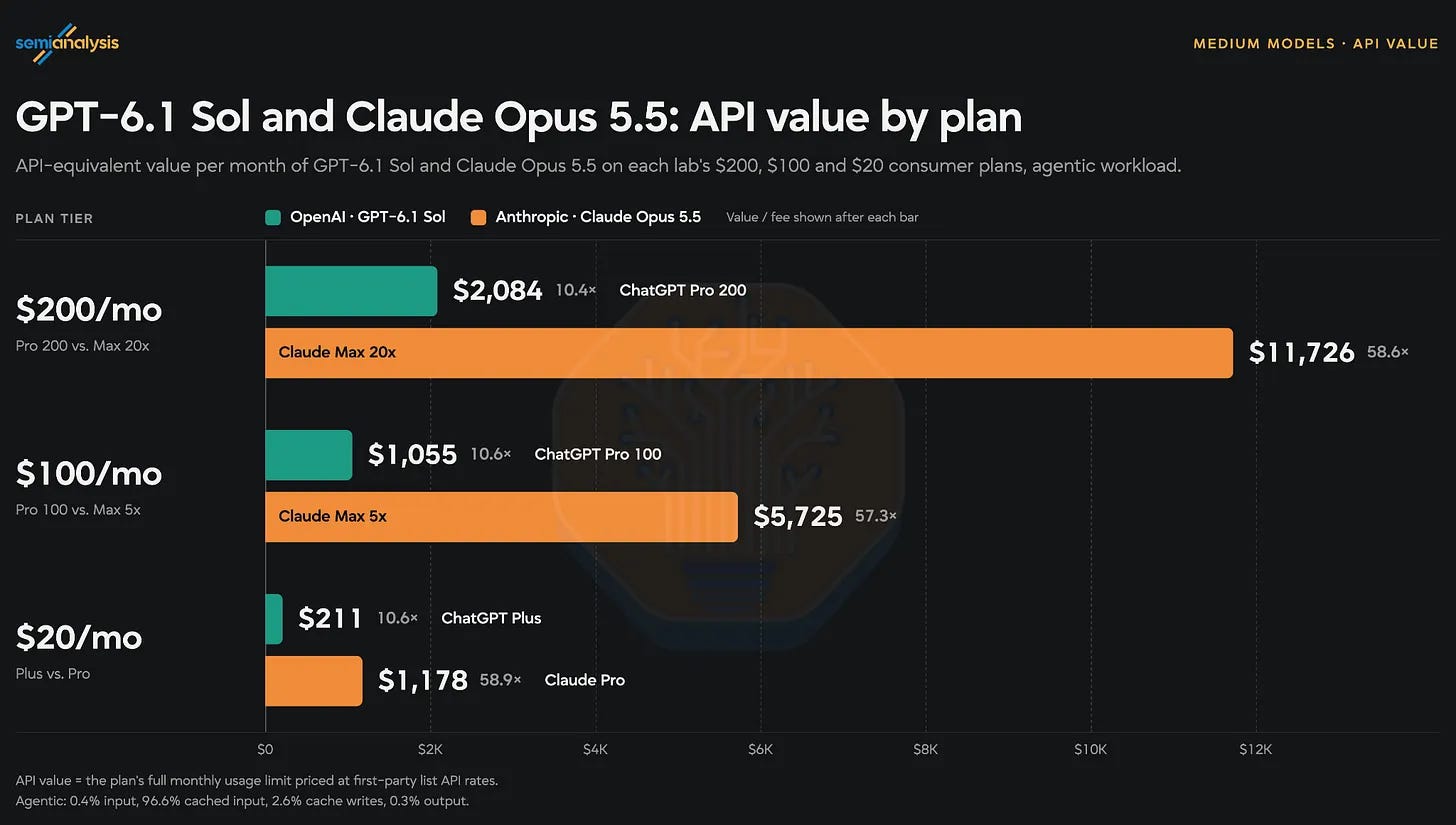
$20 a month: ChatGPT Plus gets you about $211 of usage. Claude Pro gets you $1,178.
$100 a month: ChatGPT Pro gets you $1,055. Claude Max gets you $5,725.
$200 a month: ChatGPT Pro gets you $2,084. Claude Max gets you $11,726.
OpenAI gives you back roughly 10 times what you pay on every tier. Anthropic gives you back roughly 58 times. And OpenAI is moving in the other direction. It just cut the value of its $200 plan in half and added a $500 tier. The Chinese labs are all over the map, and third-party tools built on these same models came out worse than going direct.
How can Anthropic afford this? Subscriptions are only 10% of its revenue, but they use more than 40% of its computing power. Somebody is eating that cost, and it isn't you.
The team at SemiAnalysis (Andrew Megalaa, Max Kan and Dylan Patel) did the hard work here, and you should read the full piece.
I want to go a step further. Their piece answers "who's the better deal?" The question I hear from business owners is different: should I be paying for this at all, and how much?
A subscription is a bet. The company is betting you won't use much of it, and for most people it wins that bet. They open Claude a few times a week, ask it to clean up an email, and close the tab. Your goal right now should be to make them lose.
The API works differently. You pay for every word in and every word out, like an electric meter. That's the right way to pay for things that run without a person in the chair, like an automation or an agent working through invoices overnight. A subscription is a flat fee for a human doing real work, and it comes with everything the API doesn't: Cowork, Claude Code, connectors, memory. The more of your week you run through it, the cheaper every task gets.
So where do the business plans fit? Claude's Team plan works like a subscription. You pay per seat ($25 a month for a standard seat, or $125 for a premium seat with 5x the usage, a bit less if you pay annually) and the usage comes bundled in. Enterprise is different, and this surprises a lot of people. It's $20 a seat plus every token billed at API rates, with no published discount. Bigger sales-assisted contracts can negotiate, but nobody publishes those terms. So an Enterprise seat is basically the API with a seat fee and better admin controls on top: SSO, audit logs, data retention settings and a HIPAA-ready option. OpenAI is heading the same way. ChatGPT Business and Enterprise seats now come with an allowance, and once you go past it, you're paying for credits by the token.
What that means in practice: if you have fewer than 150 people, Team is almost always the better deal, and the premium seats go to your heaviest users. Enterprise makes sense when compliance requires it. If you go that route, set spend limits per person, because your best AI user is now also your most expensive one.
Why right now? Remember when an Uber across town cost $6? That was investors paying for your ride while the company grew, and then the prices went up. AI subscriptions are in their $6 Uber era, and OpenAI has already started raising the fare. The deal won't last forever. What you build while it does will. The workflows, the skills, the person on your team who now gets a week of work done by Wednesday all stay with you when the prices change.
The most expensive mistake I see is a company putting everyone on the cheapest plan and telling them to be careful. The person who hits their limit by Tuesday afternoon is your best AI user. Give them the bigger plan.
From the Field
Claude Knows Where Your Money Went
Every household has the same monthly ritual. Open the bank app, scroll, wince, close the bank app.
Two tools changed that this year. In May, Era Context became the first personal finance connector in Claude's directory. You link your bank accounts, cards and investments once, and Claude can see your transactions, recurring charges and balances. It also has a rules engine Claude can write to, so "tag every Uber Eats order as dining and flag me if any bill goes up" becomes one sentence instead of a weekend project. It runs on MCP, so the same connection works in ChatGPT too.
OpenAI went the other way and built it straight in. ChatGPT's personal finance feature launched for Pro users in May and opened to Plus users in the US this summer. It uses Plaid to connect to more than 12,000 institutions and gives you a dashboard of spending, subscriptions and upcoming payments.
The first questions I'd ask: "What subscriptions am I paying for that I forgot about?" and "How did September compare to August, and why?"
The before is a spreadsheet you update once a month, if it happens at all. The after is a question you ask from the couch.
You still look at the answer, though. Era asks for your permission before it takes any action, and you should read what it tells you before you move money because of it. Think of it as a sharp analyst, not your financial advisor.
Why this travels: everyone has the same monthly job of figuring out where the money went. Your bank app tells you what happened. Now you can ask Claude or ChatGPT why.
AI News Worth Your Time
Three Stories From This Week
Half of people thought this video avatar was a real person
Tavus unveiled Griffin, which it calls the first "Human Interaction Model." It holds live video conversations and generates every pixel in real time, including body movement, shadows and the background. It laughs, reacts while you're talking, and reads your facial expressions. In testing, 48% of people believed they were talking to a real human after a one-minute call. For now it's a research preview for select testers only, and Tavus says it isn't releasing it to general customers until it works through the safety concerns.
My take: Video agents for sales demos and customer intake are coming, and some of them will be great. The other side of this is the one I'd act on today. If half of people can't tell after a minute, your finance team needs a rule for any video call that asks them to move money. Pick a code word this week. READ THE TAVUS ANNOUNCEMENT →
Google gives Gemini 4 Argon to the cyber defenders first
Google announced Gemini 4 Argon, its new frontier model built for long, complex work like codebase migrations, legal drafting and financial research. It can write up to 1 million tokens in a single output, up from 64,000, and it posted top scores on several coding and enterprise benchmarks. Google is rolling it out first to trusted cyber defenders through its Fairwind Program before opening it to paid API customers and Google AI Ultra subscribers. Introductory API pricing is $2 per million input tokens and $10 per million output tokens.
My take: This is the same playbook Anthropic ran with Project Glasswing back in April: hand the most dangerous capabilities to the defenders before anyone else. For a small business the lesson is boring but real. The window between a bug being found and a bug being exploited keeps shrinking, so turn on automatic updates. And at $2 per million input tokens, the price war on frontier models is good news for anyone paying an API bill. READ THE GOOGLE ANNOUNCEMENT →
OpenAI's DevDay: cheaper models, pricier plans
OpenAI's DevDay brought GPT-6.1 Sol, an upgrade with stronger coding and computer use, launched at a fifth of its standard token prices. It also added @ChatGPT inside Slack and Microsoft Teams, a meetings plugin for notes and summaries, and "Dots," always-on agents that handle ongoing responsibilities. On the pricing side, there's a new Pro 500 tier with 25 times the Plus allowance.
My take: Put the two pricing moves side by side. The API got a lot cheaper, and the top subscription got a lot more expensive while the $200 plan's value was cut in half. That's OpenAI telling power users the subsidy is over, right as Anthropic keeps it going. If your team lives in Slack or Teams, the @ChatGPT integration is the piece I'd try first. READ THE OPENAI RECAP →
That's it for this week.
If this was useful, forward it to the person at your company who approves the AI software bill. That's who this is for.
And if you want to talk about what AI could do for your business, not in theory, but in your workflows, with your team, on your timeline, reach out at [email protected]. That's what we're here for.

Dean led AI initiatives for a 500-person division at Epic Systems before founding Bridge AI, the embedded AI team for small and mid-size businesses.