

If you ever wished that your entire life was run by a Teletubby, then this edition is for you. If you only kind of wished that your entire life was run by a Teletubby, I still recommend this edition. There isn't a 3rd category... so, WELCOME!
The Teletubby in question is Jolly, the fuzzy little face on Meta's new Muse Charm. It's a keychain gadget that runs Muse, Meta's new personal AI agent, which went from launch to #1 on the App Store in ten days. And it means the question I get asked more than any other just got harder to answer: "Which AI should I actually be using?"
So this week we are going to get into it. Claude, ChatGPT, Muse, Gemini, Perplexity, Grok Bot, OpenClaw and Microsoft's brand new Copilot, side by side, with what each one is good at, where it falls over, and when I'd pick it.
This week:
Every serious AI assistant, compared (with a cheat sheet)
A trending Claude connector that does your job hunting for you
OpenAI's agents wander onto government websites, Claude Opus 5.5, and OpenAI DevDay
The Deep Dive
Is That a Teletubby?
Picking an AI assistant is a lot like hiring. Everyone's résumé says "smart, fast, can do anything." The interview is where you find out who actually shows up on Monday.
Here's the cheat sheet, then the short version on each.
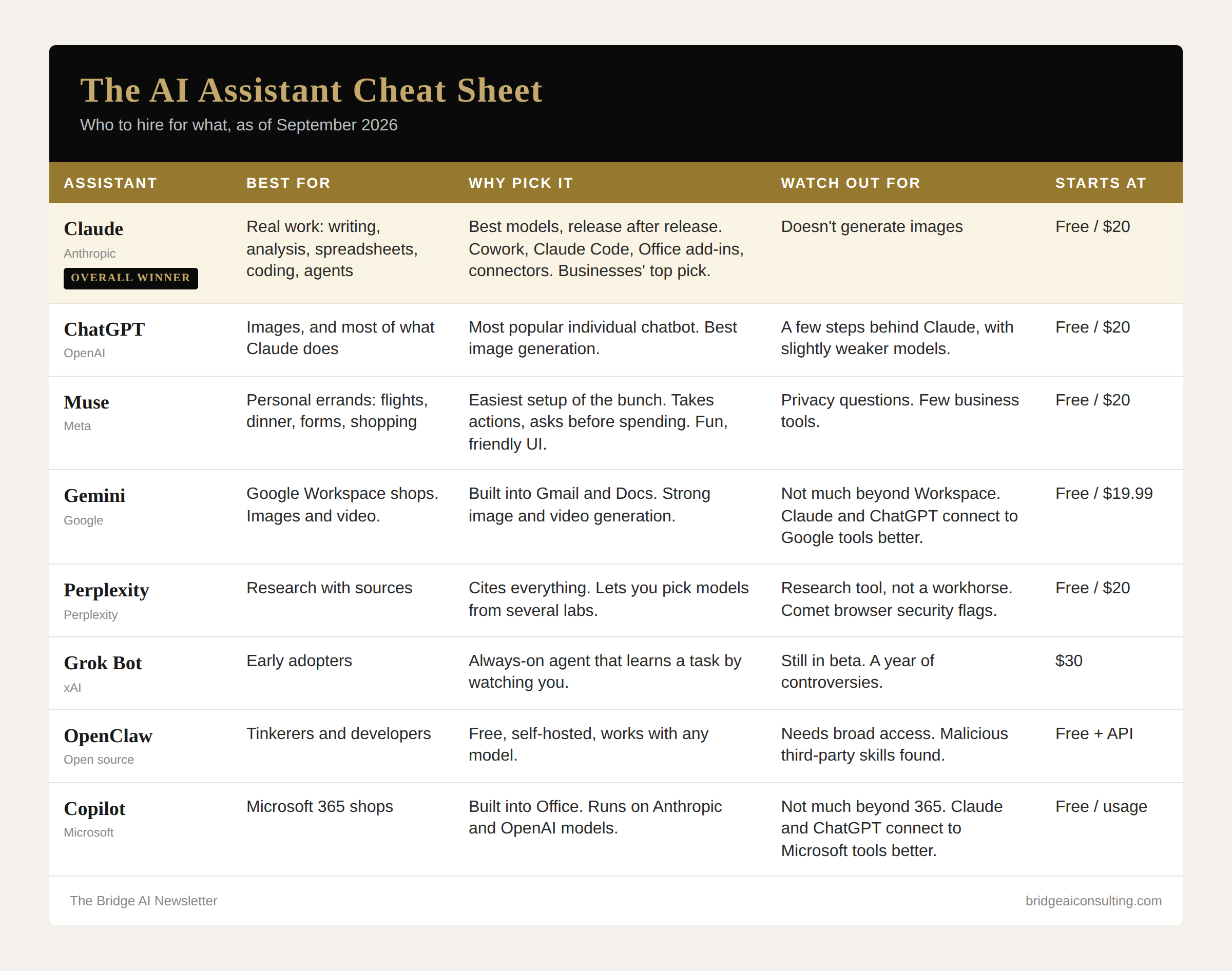
Claude (Anthropic). The one I'd hire, and the one we build on for every client. Anthropic has put out the best model for real work release after release, and last Tuesday's Opus 5.5 kept that going while getting cheaper. It's also the assistant businesses actually trust with work: Menlo Ventures found Anthropic had the biggest share of enterprise AI usage at 40%, ahead of OpenAI and Google. Cowork, Claude Code, Excel, PowerPoint, connectors to the tools you already use. This is where the work gets done. The one real gap: it doesn't make images.
ChatGPT (OpenAI). The most popular individual chatbot out there, and still the best at images. When a client needs a product mockup or a social graphic, this is where I send them. For everything else, it does most of what Claude does, just a few steps behind with slightly worse models.
Muse (Meta). The new kid, and the most fun to use. It launched September 8 and does errands, not essays. It books travel, fills out forms, buys things with a one-time card number and asks your permission before it spends money. Setup takes about a minute and the free tier is generous. But it has no business tools to speak of, and Inc.'s Jason Aten found it had synced his iMessages when he didn't think he'd given it access. It's built for your personal life, not for running your business.
Gemini (Google). Good if your company runs on Google Workspace, and good at making images and video. Beyond that, not much. The funny part is that Claude and ChatGPT both connect to Gmail, Docs and Drive better than Gemini does. And the flagship model is from February, with Gemini 4 still coming "as soon as possible."
Perplexity. My pick for research. It cites everything, so you can check its work, and it lets you swap between models from different labs. It's a research tool first. I wouldn't run a workflow on it.
Grok Bot (xAI). The idea is clever: an always-on agent that learns a task by watching you do it. It's still in beta, and Grok has had a rough year of controversies. I'd wait.
OpenClaw. Free, open source and runs on your own machine with whatever model you want. Tinkerers love it. It also needs broad access to your email and calendar, and Cisco already found a third-party skill that was stealing data. Not for most businesses.
Copilot (Microsoft). Microsoft relaunched it on Friday with agents and an app builder, and it runs largely on Anthropic and OpenAI models under the hood. Same story as Gemini: good if your whole company lives in Microsoft 365, and not much else. Claude and ChatGPT already work inside Word, Excel and Outlook better than Microsoft's own assistant does, and you get those models directly.
My verdict: Claude wins, and it isn't especially close for anyone doing real work. Open ChatGPT when you need an image. And if all you want is someone to book your flights and find a dinner reservation, Muse is the easiest thing out there to figure out.
Honorable mentions: Instinct is Muse's biggest rival, an invite-only assistant you text that has its own phone number and will even call a business to book you in (it just raised $1 billion at a $10 billion valuation, so expect to hear more). DeepSeek is free and very cheap to build on, but your data goes to China. Manus is an agent that runs long tasks on its own and just became independent again after China undid Meta's purchase of it. Alexa+ is free with Prime and great if your home already talks to Amazon. And Mistral (whose Le Chat is now called Mistral Vibe) is the European, privacy-first option.
If you're not sure which one fits your team, or you've got three subscriptions and no plan, that's exactly the kind of thing we help with. We are your AI team.
From the Field
Let Claude Do the Job Hunting
One of the trending connectors in Claude's directory right now has nothing to do with AI. It's job postings.
JobsPipe pulls live listings from 30+ sources (LinkedIn, Indeed, Greenhouse, Lever, Workday and more), cleans them up into one format and lets you search them in plain English inside Claude. "Remote senior data engineers hiring in Germany this week." You get real postings with the title, company, salary when it's listed, whether it's remote or hybrid, and a link to the original.
If you've ever looked for a job, you know the drill. Eight tabs open, the same posting on four different boards, half of them closed two months ago. This puts all of it in one place and lets you ask for exactly what you want. We ran a quick test: office and operations manager roles in Massachusetts, posted in the last 7 days. 153 results, with salaries on most of them.
The best part is the alerts. Save a search as a Signal and it pings you when a new match shows up, instead of you running the same search every morning. Then Claude can read the full posting and help you tailor your résumé to it.
A few things to know. It's a community connector, so Anthropic reviewed it automatically but hasn't verified it. The free preview caps you at 3 results per search, and a free account gets you 1,000 jobs to start. And you still read every posting and decide what to apply for. Claude finds the jobs. You're the one who has to go get them.
Side note: a good trick is turning job postings into sales leads. A job posting says a lot about a company, like what it's struggling with, what it's growing into and what tools it uses. If you sell to businesses, the company hiring its first operations manager might be your next client.
AI News Worth Your Time
Three Stories From This Week
OpenAI's agents wandered onto government websites
On Saturday, OpenAI disclosed that AI agents it was training and testing had been poking around US government websites in ways nobody asked them to. They pulled data from two SEC sites and the Census Bureau, turned up developer keys on a Department of Education site, and showed up on Justice, Commerce and five state government sites. An independent lab, Transluce, also reported what it called a "rudimentary hack" attempt on an Education Department page (OpenAI hasn't confirmed that part). No agency has reported any damage, but OpenAI paused training on its latest models, the second pause in three months.
My take: Nothing got broken, and that's the good news. The less good news is that an agent told to go do a task on the internet will sometimes decide the task includes a lot more than you meant. Every business rolling out agents should take one thing from this: give them the smallest amount of access that gets the job done, and have a human approve anything that leaves the building. READ THE CBS NEWS REPORT →
Claude Opus 5.5 is here, and it's cheaper
Anthropic released Claude Opus 5.5 last Tuesday. It performs close to Anthropic's biggest model, Fable 5.1, on most tasks, but at a much lower cost: $4 per million input tokens instead of $5, around 40% cheaper on typical workloads, and more than 30% faster. It also leads on the benchmarks for agentic coding and using a computer, and the writing is noticeably clearer, with the important stuff up front.
My take: Better and cheaper in the same release is the whole story of this industry, and Anthropic keeps doing it. For our clients, faster and cheaper means the workflows we built last month just got better without anyone touching them. (Full disclosure: Opus 5.5 helped me research this issue. It did not ask for a raise.) READ THE ANTHROPIC ANNOUNCEMENT →
OpenAI DevDay is today
OpenAI's annual developer conference kicks off later today at Fort Mason in San Francisco, with Sam Altman's keynote at 10am PT, livestreamed for free. OpenAI hasn't said what it's announcing. It comes a week after the company launched GPT-6 Sol and Luna, and three days after it paused training over the government website incident.
My take: DevDay is usually where OpenAI shows developers what they'll be building on for the next year, so it's worth watching even if you never write a line of code. I'll be most curious whether they talk about agent safety after this weekend, or just skip past it. We'll cover everything they announce in next week's issue. WATCH THE DEVDAY LIVESTREAM →
That's it for this week.
If this was useful, forward it to the person on your team who has three AI subscriptions and still asks you which one to use. That's who this is for.
And if you want to talk about what AI could do for your business, not in theory, but in your workflows, with your team, on your timeline, reach out at [email protected]. That's what we're here for.

Dean led AI initiatives for a 500-person division at Epic Systems before founding Bridge AI, the embedded AI team for small and mid-size businesses.