
Somewhere out there is a student who wrote every word of their essay themselves, ran it through Claude to fix the commas, and is about to have a very bad meeting with their dean.
Anthropic is now weaving an invisible mark into everything Claude writes. You cannot see it. It survives a copy and paste. It may even survive an edit.
I think this is great. Knowing where something came from is good.
But the interesting part isn't the technology. It's that all of us now have to answer a question we have been quietly avoiding: when do I actually care?
This week:
The one-sentence benchmark for when AI authorship matters and when it does not
Why Glinda was right
Three stories: OpenAI's Ultrafast preview, a $12B rollup buying accounting firms, and the price of intelligence falling off a cliff
The Deep Dive
Claude Now Watermarks Everything. Your Detector Will Still Accuse the Wrong Person.
The mark comes in two pieces. For text, Anthropic embeds an imperceptible watermark directly into the words. It does not change the meaning, the quality, or the readability, and it travels with the text when you paste it somewhere else. For files, Claude attaches signed provenance metadata using the C2PA standard, the same approach the camera and imaging world landed on.
Every model launched on or after August 2, 2026 has it. Older models are being retrofitted. It covers the API, Claude, Claude Code, Cowork, all of it, worldwide.
If you are a teacher grading an essay, you care. A lot. The essay was never the point. The thinking was the point, and the essay was your only evidence of it. Take away the thinking and you are grading a receipt.
If you run a business and your ops manager hands you a proposal that wins the job, you do not care even a little. You were never buying the words. You were buying the outcome.
That is the whole benchmark and it fits in one sentence. Are you paying for the thinking, or paying for the output?
Anthropic's own documentation says a detected mark means the content "may have been processed by Claude" and that "Claude may not be the original author." Read that again. Write something yourself, ask Claude to tighten it up, and it comes back marked exactly the same as if you had asked Claude to write the whole thing from scratch.
It gets worse in the other direction. Anthropic also says the absence of a mark does not mean the content was not AI generated. Heavy editing, paraphrasing, a format conversion, or a platform that strips the mark will all make it disappear.
So detection fails in both directions at once. It flags the careful writer who used a proofreader, and it waves through the person who copied the whole thing and retyped it. If your policy is "we ran it through a checker," you have built a system that potentially punishes the honest and rewards the sloppy.
The fix is not a better detector. The fix is deciding, before it happens, what you are going to do when the mark shows up.
Go back to the teacher. A kid's essay comes back marked. What does that actually mean? It could mean Claude wrote the whole thing. It could mean the kid wrote it and asked Claude to fix the grammar. It could mean they wrote it in Spanish first and had it translated. The mark cannot tell those apart and it never will, so the teacher has to decide in advance which of those they are fine with, and what actually happens in the cases they are not.
The answer is probably not a zero. It is probably "walk me through your argument," which is the evidence they wanted in the first place.
Now do that for your business. Where do you care, why, and what specifically happens when a mark shows up there? Get it on one page while it is a calm conversation, and not the day somebody on your team gets accused of something.
From the Field
Glinda Was Right
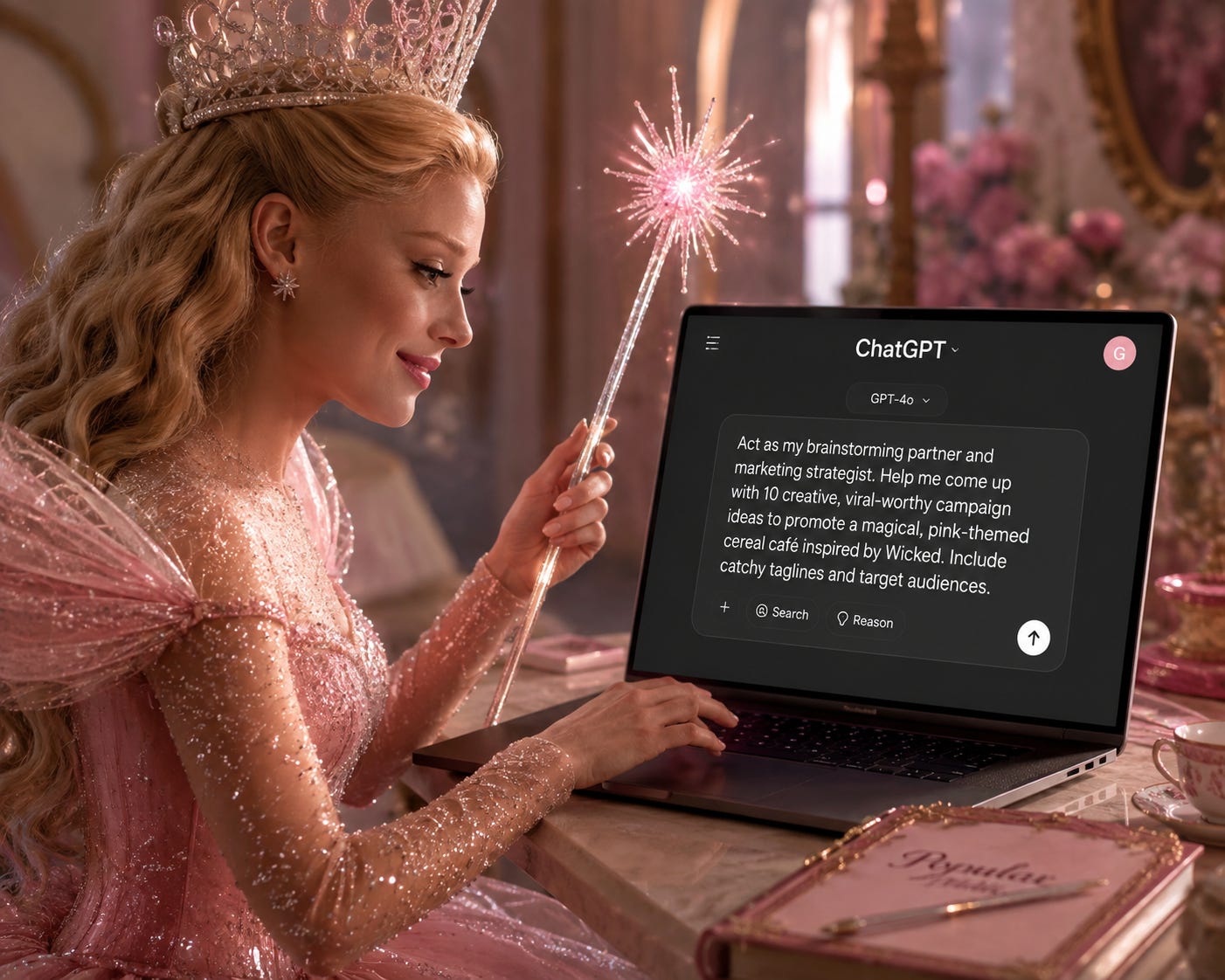
Glinda spends an entire song in Wicked on the merits of being popular. It plays as a joke because for most of life it is one. Then you look at how AI decides what to recommend, and she starts to sound like a strategist.
Mal Shaik spent some time reverse engineering how Cal, the open source scheduling tool, became the #1 tool ChatGPT recommends when somebody asks for a Calendly alternative.
His count: 47 comparison blog posts, each written as a direct answer to the exact question people type into a chatbot. Listings in 23 niche directories most competitors ignored. A GitHub repo with 45,000+ stars, which is 47,800 today. More than 200 Reddit mentions with real upvotes in the right subreddits.
His line about it: "this isnt luck. this is engineered visibility."
Muck Rack's May 2026 study looked at more than 25 million links cited by ChatGPT, Claude, and Gemini across 17 industries. 84% of citations came from earned media, meaning third party sources, not the brand's own site.
The model is not reading your About page. It is reading what other people wrote about you.
Which means the work is not on your site. It is in the places you do not own. Comparison pages, niche directories, forums, wherever people actually argue about which option is better. Those are the rooms you have to earn your way into, and almost nobody is trying.
Why this travels: every business has competitors people compare them to. Somebody is typing that comparison into a chatbot right now, and some page is going to be the answer it reads. It might as well be yours.
AI News Worth Your Time
Three Stories From This Week
OpenAI previews Ultrafast
OpenAI opened a limited preview of Ultrafast, a new API tier that runs GPT-5.6 Sol up to 14 times faster than standard processing, generating up to 750 output tokens per second. It runs on Cerebras hardware. OpenAI is pointing it at incident response, financial research, voice-based customer support, e-commerce transactions, and interactive research. Access is limited to an initial group of customers and expands as capacity grows.
My take: Speed changes which workflows are possible at all. A support agent that takes eight seconds to answer is a chatbot people abandon. One that answers before the customer finishes the thought is a phone system. The workflows that were "almost good enough" a month ago are the ones to look at again. READ THE OPENAI ANNOUNCEMENT →
A $12B firm is buying accounting practices and rebuilding them with AI
Thrive Holdings, a spinout of Thrive Capital that OpenAI has held a stake in since December, raised $2 billion at a $12 billion valuation. Its model: buy traditional service businesses and wire AI into how they actually operate. It already runs 70+ businesses across two platforms, an accounting arm with 50+ firms and 2,000+ professionals, and an IT services arm with 20 companies. Its tax product processed over 7,000 returns at 98% accuracy with 30% less prep time. Its IT arm reports resolving help desk tickets 36 times faster. Next up is a regulatory services platform for construction and infrastructure.
My take: Accounting, IT services, compliance, construction approvals. Those are the businesses on your street. Your competition may no longer be the firm across town. It may be a $12 billion buyer who bought the firm across town and gave everyone there a 30% head start. The good news is that nothing they are doing requires $2 billion. It requires deciding to do it. READ THE TECHCRUNCH REPORT →
The price of intelligence fell off a cliff this week
Google launched Gemini 3.7 Flash on August 13 at $0.75 per million input tokens and $3.75 per million output, half the previous Flash price, and it is meaningfully smarter. Production code quality jumped from 34.4% to 43.6% on FrontierCode 1.1, and business automation went from 17.0% to 30.4% on AutomationBench. In the same stretch, OpenAI cut GPT-5.6 Luna pricing substantially and Anthropic put Claude Opus 5 at roughly half the price of Fable 5.
My take: For years the honest answer to "should we automate this?" included "the model is too expensive to run it on everything." That answer is gone. Cost is no longer the constraint. Knowing what to point it at is, and that has always been the harder problem anyway. Also worth noting that Google's rate is introductory and doubles on January 1, so pilot now and budget for the real number. READ THE GOOGLE ANNOUNCEMENT →
That's it for this week.
If this was useful, forward it to the person at your company who is about to write an AI policy, or the one who already wrote one built entirely on a detector. That's who this is for.
And if you want to talk about what AI could do for your business, not in theory, but in your workflows, with your team, on your timeline, reach out at [email protected]. That's what we're here for.

Dean led AI initiatives for a 500-person division at Epic Systems before founding Bridge AI, the embedded AI team for small and mid-size businesses.