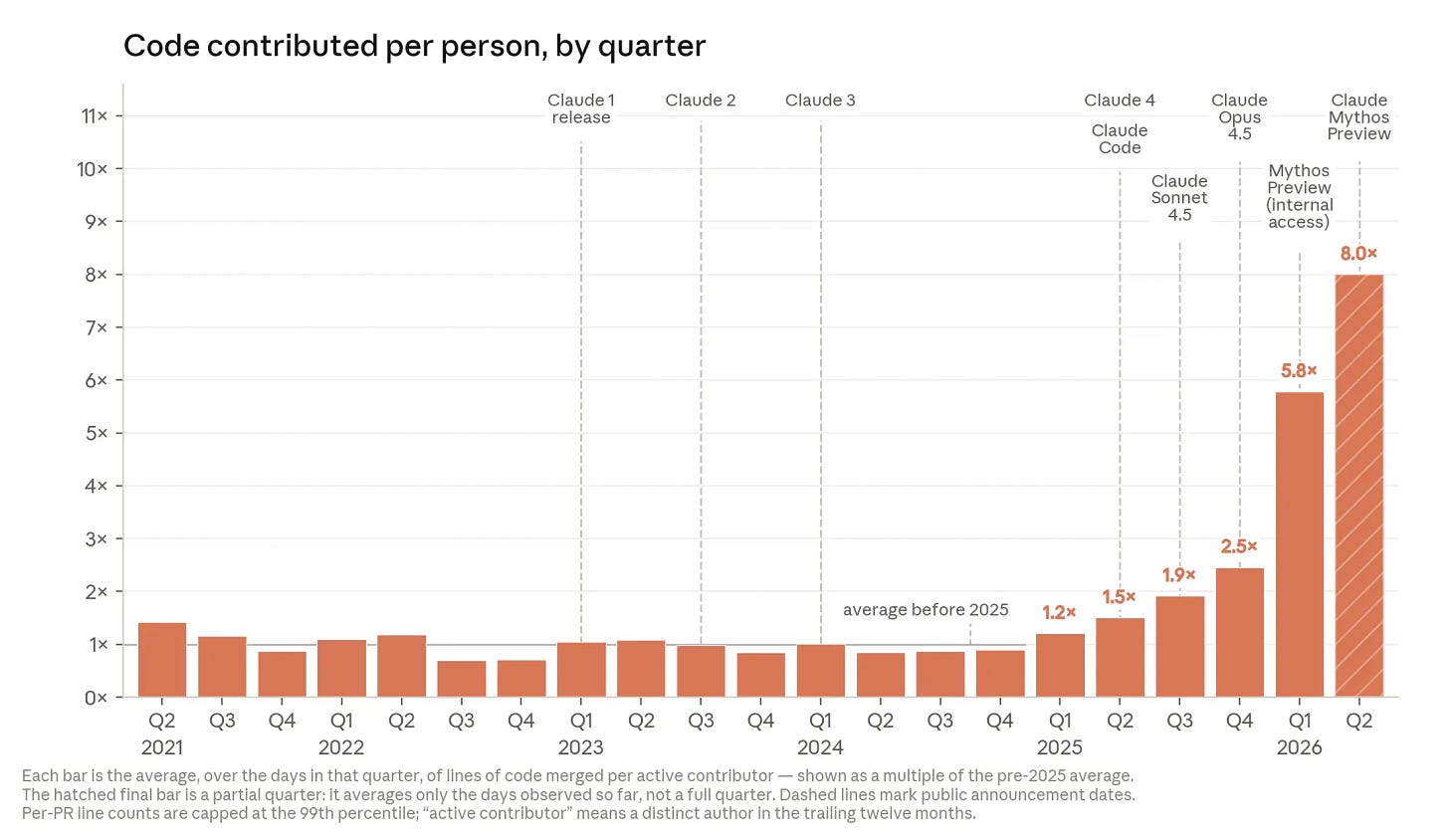
On Thursday, Anthropic put out a piece called "When AI builds itself." The headline ask is dramatic: the company wants the world to build a coordinated "pause button" so that governments and AI labs could agree to slow down frontier development if things get scary, the same way nuclear powers built arms-control regimes. Take a breath, let society catch up. That's the story most outlets ran with. Bloomberg, the works. It's worth reading, and I could talk about it and its implications for hours. But the pause button isn't what I want to talk about here. The thing I keep coming back to is one chart. It's a bar chart of how much code each Anthropic engineer ships per quarter. For four years, 2021 through 2024, the bars are basically flat. One human, one normal amount of work. Then in 2025 the line starts to climb. Then in 2026 it goes nearly vertical. The most recent bar sits at 8x the old average. Eight times the output per person. Here's the chart: Now, here's the trap. A lot of smart people look at the last couple of years and say "the pace is slowing." ChatGPT in 2022 felt like a lightning strike. Most releases since have felt a little less jarring. So the brain files it under "the exciting part is over." I think that's exactly backwards. The jumps feel smaller because we got used to them, not because they got smaller. A chart that bends straight up is not a chart that's calming down. The shock wore off. The curve didn't. So what do you actually do with that? This is where I want to be honest instead of sell you a tidy answer. The truth is the only real certainty right now is deep uncertainty. You can find a serious, credible person predicting almost anything. One camp thinks self-improving AI means we'll need universal basic income within five years because there won't be enough jobs to go around. Another camp thinks we hit a wall, a data wall or an intelligence ceiling, and we just keep getting slightly better chatbots without the sci-fi outcome. I have my own view (I don't think we hit the wall). But here's the uncomfortable part: the steps you should take for your business look completely different depending on which one is right. So the worst move isn't betting on the wrong future. The worst move is betting your whole company/life on any single future. The business owner who fires the team and goes all-in on AI is making a bet. The business owner who ignores AI and says "we're fine" is making the opposite bet. Both are betting the house in a game where nobody can see the cards. The actual play is learning how to place your palm on the ground… or rather, flexibility. There are clear, boring, real efficiencies sitting in your business right now, and you should go grab them. That part isn't uncertain at all. But the businesses that "adopt AI" once, check the box, and say "okay, we're good" are the ones that struggle. Not because they did the wrong thing. Because they did it once and stopped. "Be flexible" is easy to say and useless on its own, so here's what it actually looks like in practice. Three things, none of which require you to predict the future. First, rent, don't marry. When you bring AI into a workflow, favor month-to-month tools and reversible changes over multi-year contracts and deep custom builds welded to a single vendor. The last 10% of optimization you'd get from locking in is not worth losing the ability to switch when something better shows up in four months, and at this pace, something better will. Optionality is the asset right now. Second, put one person on "what changed this month." Give someone a couple of hours a month to track what's new and, just as importantly, to re-test the tools you ruled out earlier. The thing that couldn't handle your task in January can often handle it by June. If nobody's job is to notice that, you'll keep running last quarter's playbook on this quarter's technology. Flexibility isn't a mindset, it's a recurring slot on someone's calendar. Third, don't restructure your headcount around a forecast. Resist the urge to fire or hire purely on a bet about where AI is going. Keep humans in the loop and let the work grow into the tools, instead of betting your org chart on a future nobody can actually see yet. The reorg is the one move that's genuinely hard to undo, which is exactly why it shouldn't be the one you make on a guess. Adopting AI in 2026 isn't a project with an end date. It's building the muscle to change fast, because the ground is moving faster than it ever has and the people who survive are the ones who can pivot when it does. That's the whole reason Bridge AI exists. We don't drop in a tool and disappear. We embed, we build the muscle with your team, and we stay flexible alongside you. If "we adopted AI last year, we're set" sounds like your company, that's worth a conversation. |