
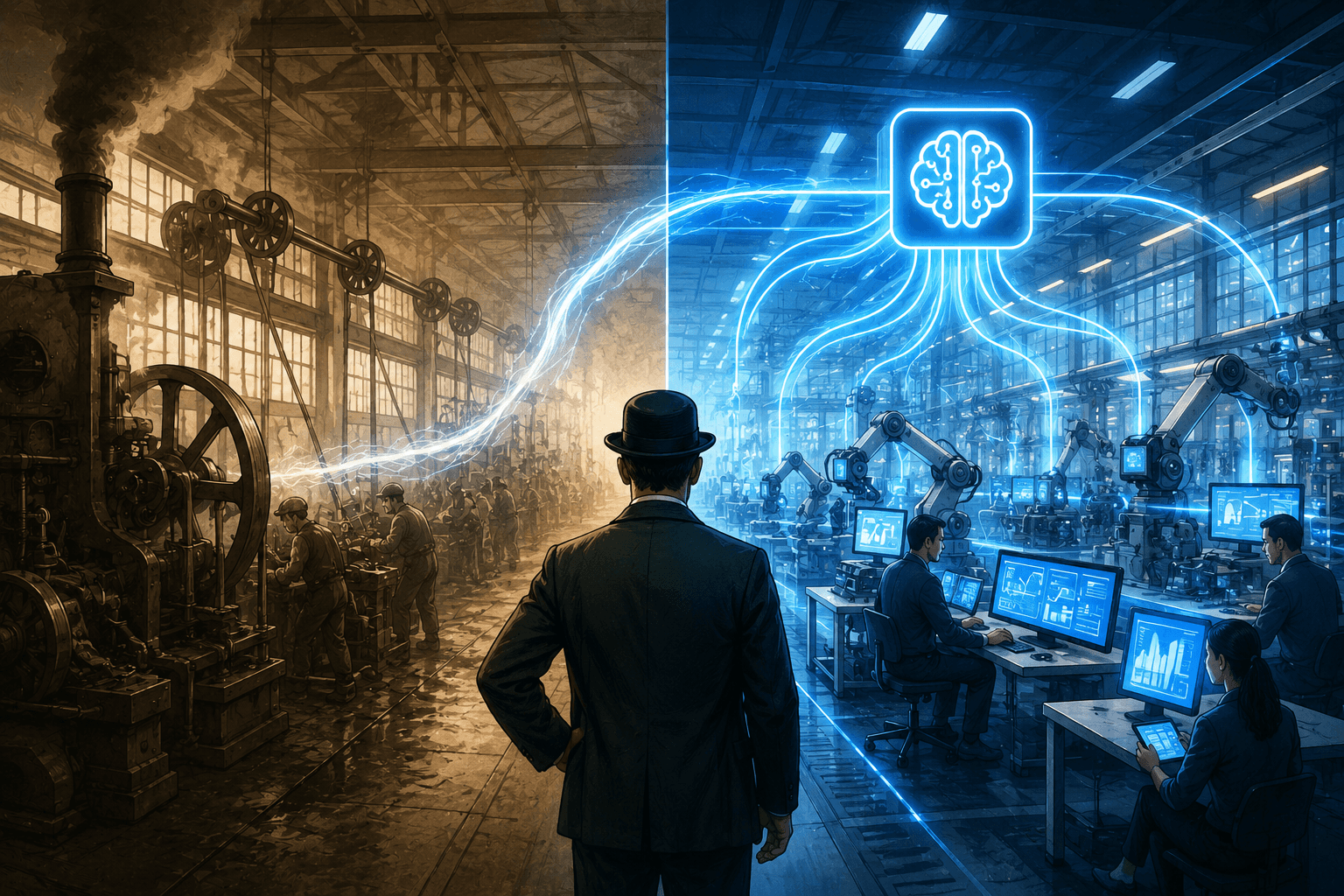
Most Companies Are Using AI Like a Steam Engine
May 8, 2026
Contents
- A Factory in 1900
- A Promise That Didn't Arrive
- What You Couldn't See
- You Already Know Where This Is Going
- The Steam Engine Mistake
- What Electricity Actually Teaches Us
- A Quick Note Before You Go
Most people compare AI to the internet. I think that comparison is wrong.
The internet was a distribution technology. It connected things that already existed and changed how information moved between them. Real change, but vertical. Commerce got better. Content got cheaper to publish. Communication got faster. Most companies still ran their internal operations the same way they did in 1995.
AI is something different. It's a power technology, in the same way electricity was. It doesn't just connect things. It changes the cost and shape of doing the work itself. Every department. Every workflow. Every role. Horizontal across the whole economy.
That's why the closest parallel in business history isn't the internet. It's electricity. Same horizontal sweep across every industry and function. Same collapse in the cost of doing the actual work. Same dependence on a new infrastructure layer that had to be built before anyone could capture the value. Same eventual rewrite of how companies were organized around it. The lessons hiding in that forty-year gap between when electricity arrived and when companies finally knew what to do with it are the most useful lessons available to anyone trying to figure out where AI is going right now.
All of it is most visible in 1900.
A Factory in 1900
Imagine you own a textile mill in Pennsylvania in the spring of 1900.
Walk in through the side door at six in the morning. The smell hits first. Leather, hot oil, and something faintly metallic. Above your head, a steel shaft runs the entire length of the building, two stories up, spinning fast enough that you can feel the vibration through the floorboards. A dozen leather belts cascade down from it, slapping the air on their way to the machines. Oil drips constantly from the shaft above onto whatever's below.
Look at how the floor is laid out. Every machine is positioned directly under the belt that drives it. The looms run in two long parallel rows because that's where the shaft routes power. There's a corner where the work bottlenecks every day, and you've thought a hundred times about moving those frames to the other side of the building. But you can't. The belts won't reach. Your engineer has done the math. This kind of layout wastes roughly 40% of usable floor space. You believe him.
This is the most efficient factory in America.
You've heard talk about Edison's new electric station downtown. You read the article in Scientific American last year. They say the future is electric. You're starting to think they might be right.
A Promise That Didn't Arrive
Now imagine it's a few years later. You took the leap. You read everything you could find. You went to the World's Fair and saw the dynamos turning. You convinced your partners that the future was electric. You spent the capital. You bought a big electric motor, hooked it up at the end of the line shaft where the steam engine used to sit, and threw the switch.
It worked. The shaft turned. The belts dropped. The looms ran.
You waited for the productivity gains to show up.
The cost of operations went down a little. You didn't have to keep coal in the building anymore. The fire risk dropped. Those were real wins. But the production numbers? Roughly the same. The bottleneck in the corner is still a bottleneck. The wasted 40% of your floor is still wasted. Your output per man-hour barely moved.
You don't say it out loud, but you start to wonder whether the future of electricity was oversold. Your partner says it more bluntly at the next quarterly meeting. Your competitor across town who didn't switch is making the same parts you are with the same number of men. You're starting to feel foolish for spending the capital.
You aren't alone. Seventeen years after Edison's Pearl Street Station opened in lower Manhattan, electricity provided less than 5% of US manufacturing horsepower. Most owners who tried it had stories like yours. The economist Paul David, looking back later, would describe this period as a productivity paradox. A transformative technology was already visible everywhere, just not in the actual productivity numbers.
You weren't using electricity wrong, exactly. You just weren't using it for what it was actually good for.
What You Couldn't See
Here is what you couldn't see, standing on your factory floor in 1900.
The advantage of electricity wasn't that it could turn your shaft. It was that, for the first time in industrial history, power could be put anywhere in the building. Independently. On every individual machine. The day you saw that, the whole factory became something you could redesign instead of something you were stuck with.
The owners who figured that out built the modern American economy. The most famous example: October 7, 1913, in a Detroit plant called Highland Park. Henry Ford opened something nobody had quite seen before. Within a few years, Model T assembly time had dropped from 728 minutes to 93 minutes. That isn't an efficiency improvement. It's a different category of operation.
By 1929, electricity had grown from less than 5% to 78% of US manufacturing horsepower. Manufacturing productivity in the 1920s grew at rates that rebuilt the country and built the modern middle class. The production line. Mass production. The modular factory. None of it is about electricity. All of it is about what electricity made possible once factory owners stopped using it like a steam engine.
You Already Know Where This Is Going
Several years into the AI boom, sit in any executive meeting and you will hear something that should sound very familiar.
Someone bought ChatGPT licenses for the team. Someone ran a pilot in marketing. The numbers came back okay. Some hours were saved. People liked it. But the productivity revolution everyone promised hasn't really arrived. Every quarter the leadership team comes back to the same conversation. Half-defensive, half-confused. Maybe AI is overhyped. Maybe it's a tool, not a transformation. Maybe we should keep our heads down and wait for things to clarify.
That executive is the factory owner in 1900. The technology isn't the problem. The way it's being used is.
The Steam Engine Mistake
The marketer uses ChatGPT to draft an email faster. The analyst uses it to clean up a spreadsheet. The engineer uses it to autocomplete code. The salesperson uses it to summarize a CRM note.
Same job. Slightly less manual. The savings are real but small. The bottleneck doesn't move. The work doesn't really change. AI got installed at the end of the existing line shaft.
That is the steam engine mistake.
What Electricity Actually Teaches Us
The steam engine mistake is just the first lesson. There are more, and they all come from the same forty-year gap.
Power Has to Reach Every Corner
The first thing electricity made possible wasn't a better factory. It was a factory where power could go anywhere. A small motor on every machine. Power available, on demand, in every corner of the building.
That changed what power meant. Electricity wasn't just lighting and motors. Eventually it was telephones, refrigeration, ventilation, radio, elevators, air conditioning, mass transit. The technology turned out to be horizontal. There wasn't a single industry or function it didn't end up rewriting. The owners who only thought about it as "a thing that powers the looms" missed nine-tenths of what it could do.
AI is the same kind of technology. The companies that win with it won't be the ones that put a chatbot in the customer support function and call it done. They'll be the ones that make AI and the right data available in every corner of their operation. Marketing, finance, ops, sales, product, HR, legal, executive decision-making. Every team. Every role. Every workflow.
One pro sports team we work with is doing exactly this. 13 games, over 8,000 tickets, 5,000+ fans, 1,500+ sponsors, 400+ groups, 50 players, and 40+ staff records, all consolidated into one connected database wired to Claude. Anyone in the front office asks a question in plain English and has an answer in two minutes. The information that used to be locked across four different platforms is now available in every chair.
If your team's relationship with AI is "someone in marketing has a ChatGPT subscription," you have a steam engine.
Layout Follows the Work
Highland Park wasn't more electrified than other factories. Plenty of factories had electricity by 1913. The difference was the layout. Machines arranged in the order that parts moved through them. Conveyors that brought the work to the worker. Specialists at each station because no one had to walk back to the line shaft for power. It wasn't a better-lit version of an old factory. It was a different shape entirely.
That's where the productivity actually came from. Not the motors. The layout they enabled.
The same is true with AI. The work doesn't get faster because someone uses ChatGPT to type a draft. It gets faster because the entire process gets redesigned around what AI makes routine. The marketing team doesn't write better copy faster. It rebuilds the way it segments, drafts, tests, and ships campaigns from end to end. The ops team doesn't process expense reports faster. It rebuilds the workflow so the report writes itself, the approval routes itself, and a human spends thirty seconds reviewing the exception cases.
One performance marketing agency we're working with rebuilt how they produce client decks. The old process took the team over ten hours a week per client. The new process takes under an hour. The same employees who used to format slides now spend their time on creative work, vision, and review. The agency is taking on materially more clients without growing the team. The decks aren't faster. The work is shaped differently.
This is the part that makes leadership uncomfortable. It isn't a tooling change. It's an org change. Roles shift. Workflows get rewritten. The way you grow stops being about hiring more people. The companies that try to capture AI's value without redesigning anything will get the same modest gains the textile owner got in 1900.
The Bottleneck Just Disappeared
Every business in human history has been built around the same constraint. How much manual work one person can produce in a day. Everything about how companies are structured, hired, managed, and paid traces back to that bottleneck. Roles exist where they exist because a human had to do that work. Headcount budgets work the way they do because the only way to do more was to hire more.
That bottleneck is gone.
Not "smaller." Gone. The thing your company has been organized around for its entire existence just stopped applying.
Once you really see that, the picture of work inside a company starts to change. The analyst doesn't pull a quarterly report by stitching data from four platforms; the data sits behind a chat box and the report writes itself. The salesperson doesn't manually scan the internet for leads; a system surfaces the right ones every week. The recruiter doesn't process resumes one at a time; the system triages thousands and surfaces the dozen worth a human conversation.
One client of ours used to spend several hours a week scrolling Instagram for the right athletes and agents to add to their pipeline. Their lead-gen system now runs in under thirty minutes and delivers the best weekly leads ready to go. Same team, materially more outreach.
The factory revolution didn't happen until every machine had its own motor. The AI revolution at your company won't happen until every employee has agents tailored to their specific role. Not one shared chatbot pointed at one shared data source. Every role, every workflow, every person.
The Gap Has Never Been Technical
Pearl Street Station opened in 1882. The productivity boom didn't arrive until the 1920s. Forty years. The technology was available the entire time. What took those forty years was the imagination. The time it took for managers and engineers to see past the shape of the old factory to the shape of the new one.
That is the gap with AI right now. And it isn't going to take forty years this time. The signal moves faster, the frontier moves faster, and the distance between the companies that figure it out and the ones that don't is going to compound at speeds the textile owner in 1900 couldn't have imagined.
The companies that pull ahead in the next decade won't be the ones with the best AI tools. They'll be the ones that imagined past the old factory first.
A Quick Note Before You Go
If you're reading this and starting to suspect that your own AI rollout is more "electric motor on the end of the line shaft" than rebuild-the-floor, you're not alone. Almost every company we've ever worked with started there. The way out isn't more tools. It's a redesign.
That's most of what we do at Bridge AI Consulting. We sit with companies, map every workflow end to end, and help them rebuild the floor.
If you'd like to talk about what that could look like in your business, our front door is here: bridgeaiconsulting.com/contact. Otherwise, just sit with the idea. The hardest part of the next decade for most companies won't be implementing AI. It will be seeing past the factory they've already built.